
Key Takeaways
- Free Admission and Parking: The museum offers world-class exhibits and a deep historical experience without any entry fees, making it one of the most budget-friendly yet high-quality stops on the East Coast.
- Immersive “You Are There” Experiences: Unlike traditional museums, this facility uses sensory technology-including temperature-controlled rooms and surround sound-to place you directly into historical battles.
- Perfect I-95 Pitstop: Located just minutes off the highway in Triangle, Virginia, it provides a spacious, climate-controlled environment to stretch your legs, grab a meal at the iconic Tun Tavern, and recharge during a long road trip.
A Monument on the Horizon: Discovering the National Museum of the Marine Corps
If you have ever driven the stretch of I-95 through Northern Virginia, just south of Washington, D.C., you have likely seen it: a soaring, 210-foot stainless steel spire tilting toward the sky at a sharp, purposeful angle. This striking piece of architecture isn’t just a modern art piece; it is a tribute to the iconic flag-raising on Iwo Jima and the centerpiece of the National Museum of the Marine Corps.
For the road-weary traveler, I-95 can often feel like an endless ribbon of asphalt and taillights. However, tucked away in Triangle, Virginia, right on the edge of the Quantico Marine Corps Base, lies one of the most immersive and emotionally resonant museums in the United States. Whether you are a history buff, a military veteran, or simply a family looking for a place to stretch your legs and see something spectacular, this museum is a “must-visit” destination that turns a standard road trip into an unforgettable journey.
First Impressions: The Leatherneck Gallery
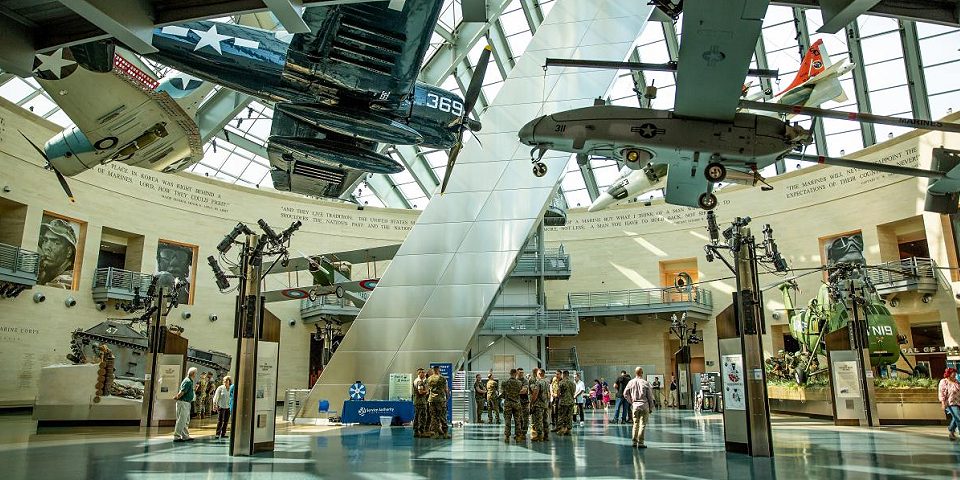
From the moment you pull into the spacious (and free!) parking lot, the scale of the museum begins to sink in. The building itself is a masterpiece of design, meant to evoke the image of the Marines raising the American flag during World War II. As you walk through the front doors, you are greeted by the Leatherneck Gallery. This massive, glass-ceilinged atrium serves as the museum’s hub.
Looking up, you’ll see vintage aircraft suspended in mid-air as if caught in a moment of flight. The natural light flooding the space creates an atmosphere of reverence and awe. It is here that you realize this isn’t a dusty collection of artifacts behind glass; it is a living history. The gallery sets the stage for the chronological journey you are about to take through the “American Experience” seen through the eyes of the United States Marines.
Stepping Into History: The Immersive Galleries
What truly sets the National Museum of the Marine Corps apart is its commitment to immersion. The curators have gone to extraordinary lengths to ensure that you don’t just see history-you feel it.
As you move through the chronological galleries, you start with the founding of the Corps at Tun Tavern in 1775 and move through the early 19th-century conflicts. But the museum truly hits its stride as you enter the 20th century.
The World War II Gallery is a breathtaking tribute to the “Greatest Generation.” You will find yourself standing next to a Higgins boat-the landing craft used to storm the beaches of the Pacific. One of the most sacred items in the entire museum is housed here: the actual American flag raised by Marines on Mount Suribachi during the Battle of Iwo Jima. Seeing the fabric of that flag, weathered and worn, brings a lump to the throat of almost every visitor.
Moving into the Korean War Gallery, the museum uses a “sensory experience” that catches many by surprise. To replicate the brutal conditions of the Battle of the Chosin Reservoir, the museum maintains this specific gallery at a significantly lower temperature. As you walk past life-sized figures of Marines huddled in the snow, the chill in the air makes the history tangible. You aren’t just reading about a cold winter; you are shivering along with the ghosts of the past.
In the Vietnam War Gallery, the immersion continues. You step out of a simulated CH-46 sea knight helicopter and into a hot, humid environment that replicates “Hill 881 South.” The sounds of distant rotors and jungle noises fill the air. It is a powerful, visceral way to understand the environment these young men faced.
Modern Conflicts and the “Making Marines” Exhibit
The museum has recently expanded to include extensive galleries covering the Global War on Terror, including the conflicts in Iraq and Afghanistan. These exhibits use modern technology and personal stories to explain the complexities of 21st-century warfare.
For those curious about how a civilian becomes a Marine, the “Making Marines” exhibit is a fascinating look at Boot Camp. You can stand on the “yellow footprints” where every recruit begins their journey at Parris Island or San Diego. You can even test your aim at a laser-shot rifle range, giving you a tiny glimpse into the marksmanship training that is a hallmark of the Corps.
A Place for Reflection: Semper Fidelis Memorial Park
If the intensity of the indoor exhibits becomes overwhelming, or if you simply need some fresh air, the museum grounds offer the Semper Fidelis Memorial Park. This 23-acre park features winding, paved paths that are perfect for a brisk walk. Along the trails, you will find various monuments, memorial bricks, and quiet benches overlooking the woods of Quantico. It is a peaceful place to reflect on the stories you’ve just encountered inside. The park is also pet-friendly (on the paths), which is a huge plus for travelers driving with their dogs!
Dining at the Iconic Tun Tavern
No visit to the museum is complete without a stop at Tun Tavern. Named after the birthplace of the Marine Corps in Philadelphia, this on-site restaurant is themed as an 18th-century colonial tavern. The wood-paneled walls and warm lighting provide a cozy atmosphere to enjoy a hearty lunch. Their menu features classic American fare-everything from “The Commandant’s Burger” to fresh salads and seafood. It is far superior to your typical museum cafeteria and offers a great chance to sit down and discuss what you’ve seen over a delicious meal.
Why It’s the Ultimate I-95 Stop
If you are traveling between New York and Florida, or anywhere in between, the National Museum of the Marine Corps is strategically located to be your best break of the day.
First, the convenience is unbeatable. It is located less than two miles from the I-95 exit. You don’t have to navigate heavy city traffic or hunt for parking. Second, the cost is a major factor. With free admission, a family of four can spend three hours being entertained and educated for the price of… well, zero dollars.
Third, the facilities are top-notch. The restrooms are clean, the building is climate-controlled, and there is plenty of room for children to move around. It offers a much-needed mental break from the “highway hypnosis” that sets in during long drives.
The Details
Address:
The National Museum of the Marine Corps
1775 Semper Fidelis Way
Triangle, Virginia 22172
Telephone: (800) 397-7585
Website: https://www.marineheritage.org/nmmc
Hours of Operation:
Monday: 9:00 am – 5:00 pm
Tuesday: 9:00 am – 5:00 pm
Wednesday: 9:00 am – 5:00 pm
Thursday: 9:00 am – 5:00 pm
Friday: 9:00 am – 5:00 pm
Saturday: 9:00 am – 5:00 pm
Sunday: 9:00 am – 5:00 pm
Closed Thanksgiving & Christmas
Admission:
Free admission
Free parking
Directions:
From I-95 north or south: I-95 to exit 150 (VA619), then VA619 east approximately 0.25 mile to US Route 1, then US Route 1 south approximately 0.25 miles to the National Museum of the Marine Corps entrance on your right.
Insider Tips for Your Visit
- Look for the Docents: “Many of the volunteers wearing red vests are actually retired Marines. If you see one, don’t be afraid to ask a question; they often share incredible personal stories that provide a deeper perspective than any plaque on a wall.”
- Visit During “Off-Peak” Hours: “To avoid large school groups or tour buses, try to arrive right when the museum opens at 9:00 AM or after 2:00 PM. This allows you to experience the immersive galleries with fewer crowds and more quiet for reflection.”
- Check the Weather for the Park: “If you plan to walk the Semper Fidelis Memorial Park, bring a light jacket even in summer. The wooded trails can be cooler than the parking lot, and you’ll want to be comfortable while exploring the various monuments located along the ridge.”
The I-95 Exit Guide is the Internet’s largest and most complete website dedicated to Interstate 95 travelers. Find detailed exit service listings… lodging, camping, food, gas and more for every exit from Maine to Florida!
On the road? Why not take us with you. The I-95 Exit Guide is mobile-friendly and totally FREE. No App Required.
Traveling another route? Visit our growing family of exit guides: I-4 Exit Guide, I-5 Exit Guide, I-10 Exit Guide, I-75 Exit Guide, I-80 Exit Guide and I-95 Exit Guide. Detailed exit service listings… discount lodging, camping, food, gas and more for every exit along the way!













We’ve seen the building from Interstate 95 for years and always wondered what it was. I think the next time we head that way, we’ll stop and check it out!
Is there RV parking at the Marine Museum? [email protected]
From their website:
“Museum parking for handicapped visitors and oversized vehicles is available”
https://www.usmcmuseum.com/location.html
Great stop!
Good info. Thanks!